
If the last few weeks have felt like the wheels are coming off, you’re not imagining it. Microsoft went down. Banks went down. Flights were grounded. Add a nuclear alert in Monroe County and an emergency broadcast cutting into TV and radio, and it’s no wonder people are uneasy.
So let’s take a breath and go through it one piece at a time.
The Microsoft 365 outage felt like a cyberattack. It was a software bug.
On November 12, Microsoft 365 went down for nearly a day, taking Outlook and Teams with it for people and businesses around the world. Microsoft traced it to a hidden flaw left behind by an earlier network upgrade. When a later network change set it off, servers dropped offline and the rest were overloaded. No hackers: Microsoft said it wasn’t a cyberattack.
It felt like the banking system was cracking. It was a rough day of glitches.
On November 16, customers at Chase, Bank of America, U.S. Bank and others reported problems logging in and using services. Frustrating, but these were service disruptions, not a collapse.
It felt like it was all connected. These were separate systems.
The FAA’s nationwide ground stop on November 13 was its own air traffic control communications problem, still under review. Different companies, different systems, different causes. The timing is what made it feel like one story.
It felt like a nuclear emergency. It was a drill message sent by mistake.
On November 5, Monroe County accidentally sent a shelter-in-place alert about the Fermi 2 plant during a drill. Officials retracted it within minutes. There was no emergency.
It felt like the government was preparing for something. It was a routine test.
On November 17, FEMA and the FCC ran a nationwide Emergency Alert System test, briefly interrupting TV and radio. It was announced back in September, and FEMA is required by law to run one at least every three years. And no, it wasn’t a warning about a blackout. FEMA said there was “no secret emergency.”
So why does it feel like a wave?
More of our lives now run on a handful of big platforms. When one stumbles, millions of people feel it at once, and the news covers every one. Outages haven’t become mysterious. They’ve become louder.

What actually matters for your business
When Microsoft went down, our phones lit up. People didn’t know whether to wait, restart, reset passwords or panic. The businesses that came through it best had a plan before it happened.
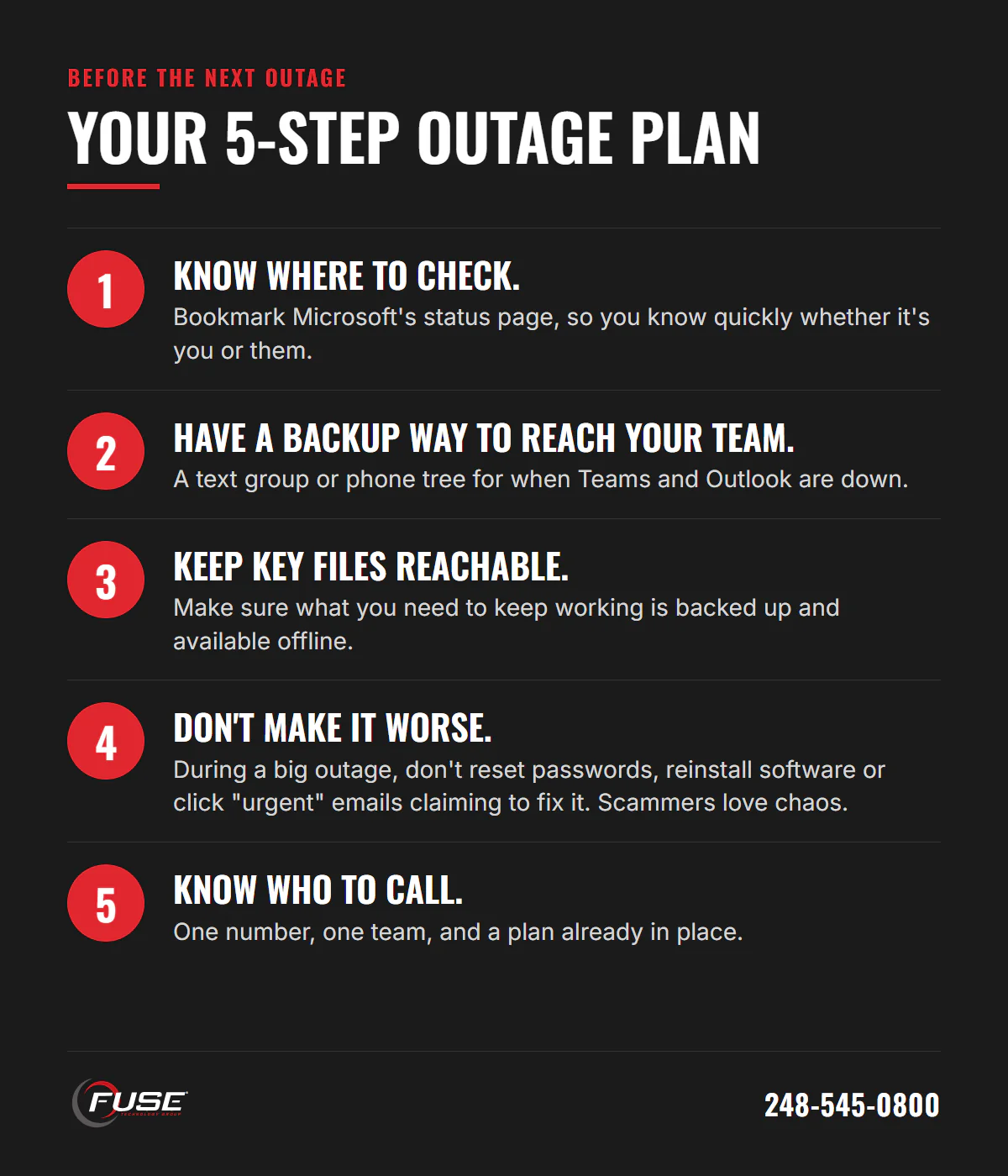
A simple business outage plan
- Know where to check. Bookmark Microsoft’s status page, so you know quickly whether it’s you or them.
- Have a backup way to reach your team. A text group or phone tree for when Teams and Outlook are down.
- Keep key files reachable. Make sure what you need to keep working is backed up and available offline.
- Don’t make it worse. During a big outage, don’t reset passwords, reinstall software or click “urgent” emails claiming to fix it. Scammers love chaos.
- Know who to call. One number, one team, and a plan already in place.
The bottom line
Things will go down again. That’s the nature of technology. But you don’t have to feel helpless when it happens. If you’d like help putting a simple outage plan together for your business, our Michigan team is here. Talk to our team: 248‑545‑0800.